
Trust & Safety
Dealing With Brokers in Addis Ababa Without Losing Control of the Deal
A practical guide to handling brokers when renting or buying a home or car in Addis Ababa, including distraction tactics, hidden commissions, verification, negotiation, and safe payment.
Sep 10, 2026 · 12 min read
In Addis Ababa, a broker can be the person who knows which apartment is quietly available, which owner is ready to negotiate, or which car has just entered the market. That access is useful. It can also place one person between the buyer and nearly every fact that matters.
The safest approach is not to assume that every broker is dishonest. It is to make trust unnecessary. Treat the broker as the person making an introduction, then verify the property, vehicle, owner, price, documents, condition, and commission independently.
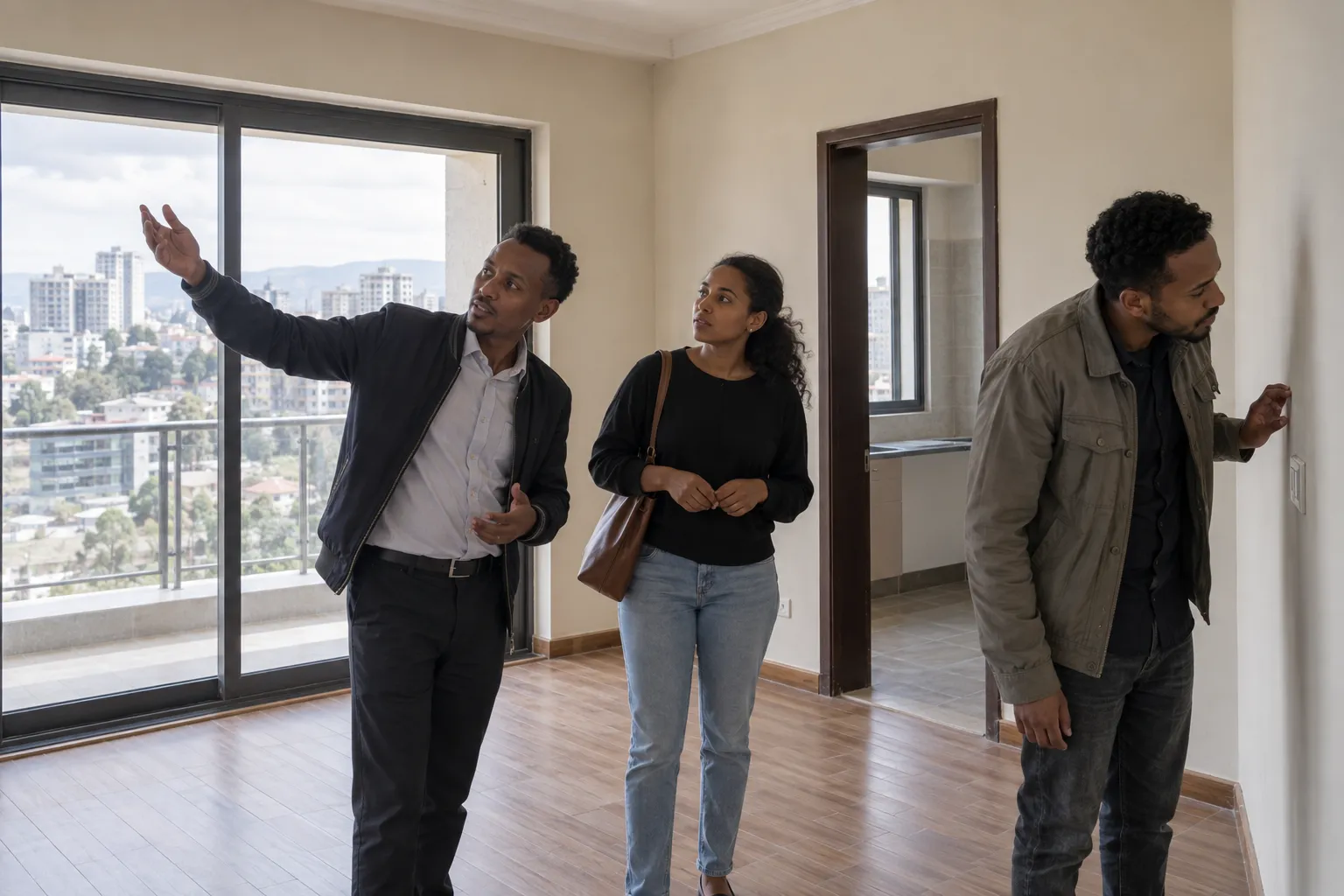
Image: Created for Addiyon.
A Broker Is an Intermediary, Not the Evidence
Ethiopia's Ministry of Justice explains that the Commercial Code defines brokers as people or businesses that professionally bring parties together for contracts such as sales and rentals. It also treats brokers as traders with legal duties, not simply helpful bystanders. Under the Ministry's explanation of Articles 54 to 57, a broker normally connects the parties; receiving money or taking steps that bind them requires a specific contractual basis. The broker may also lose the right to remuneration when acting against a client's interest or secretly taking payment from the other side (Ministry of Justice).
That distinction matters during an Addis deal. A broker may know the owner, possess a key, hold a copy of the vehicle's ownership document, or speak with complete confidence. None of those facts proves ownership, authority to sign, freedom from debt or dispute, or the condition of the asset.
A useful sentence to remember is: the broker introduces; the owner and official records prove.
When Constant Talking Becomes a Distraction
An apartment viewing should be a quiet inspection, but it can turn into a performance. The broker may fill every pause with stories about the neighbourhood, another interested customer, the owner's urgent travel, the quality of the finishing, or how quickly prices are rising. In a car viewing, the same noise may follow the buyer around the engine bay and continue through the test drive.
Talking a lot is not proof of deception. Some people are simply talkative or enthusiastic. But the effect can still be the same: attention moves from the leaking pipe, fresh paint, weak water pressure, warning light, unusual engine sound, or mismatched document to the broker's story. Research on complex decisions finds that attention and deliberate thought are limited resources, so the way information is presented can affect decision quality (Journal of Business Research).
Take control politely. Say that questions will come after ten quiet minutes. Walk through each room in the same order. Open the cupboards, run the taps, test the sockets, look behind curtains and furniture, and listen near the bathroom and pump. For a car, ask the broker to remain silent while the engine starts cold, then let an independent mechanic inspect it without the broker answering on the seller's behalf.
If quiet inspection is resisted, the viewing is over. A serious asset should survive silence.
Control the Route, the Time, and the Questions
Pressure works best when the broker controls the day. One apartment becomes five rushed stops across the city. A promised car is suddenly somewhere else. A second broker joins the conversation. By the final viewing, the customer is tired, confused about which price belonged to which place, and ready to accept whatever is in front of them.
Set the rules before leaving. Ask for the exact area, basic details, asking price, broker's role, expected commission, and whether the owner will be present. Limit the number of viewings. Keep notes under each listing and do not negotiate while travelling between properties.
Return for a second viewing when the decision is expensive. See a home in daylight and again when water, traffic, parking, lift use, neighbourhood noise, and compound access can be judged properly. Test-drive a car on a route that includes rough road, normal traffic, braking, turning, and enough time for the engine to warm up.
The phrases “another buyer is coming,” “the owner needs an answer now,” and “this price is only for today” may be true. They are still not reasons to skip verification.
Ask Who the Broker Actually Represents
The person showing the asset may have been called by the owner, another broker, or somebody several links away. Each extra link can change the price and create another commission claim. Before a viewing, ask for the broker's full name, working phone number, business name and licence where applicable, who instructed them, and whose interests they represent.
Then ask the uncomfortable but necessary questions: Is the broker being paid by the owner or seller? Is payment also expected from the buyer or tenant? Are other brokers sharing the fee? What exact event earns the commission?
Put the answer in a message before the introduction is made. The Ministry of Justice's explanation says remuneration is tied to the brokerage arrangement and, unless agreement or established practice says otherwise, the party who requested the service pays. It also says the broker should inform the parties of the conditions of the proposed agreement (Ministry of Justice). A vague promise to “talk about commission later” invites a dispute precisely when the customer is most committed.
Keep the Owner, Price, and Commission Separate
Whenever possible, speak directly with the owner or legally authorized representative. Confirm the advertised price without the broker in the middle of every sentence. Ask the owner what is included, what is defective, what has changed, and what has already been promised.
Do not let three different numbers become one confusing payment. The asset price belongs in the sale or rental agreement. The deposit or advance needs its own purpose and receipt. The broker's commission needs a named payer, amount or formula, due point, and proof of payment.
Never send a deposit to a broker merely because the broker has a key or says the owner is unavailable. Commercial Code rules described by the Ministry make clear that a broker does not automatically have authority to receive money for the parties (Ministry of Justice). Pay the person legally entitled to receive it, through a traceable method, after the required verification and written agreement.
For an Apartment or House, Verify More Than the Door
Access proves access. It does not prove the right to rent or sell.
For a rental, compare the owner's identification with current property records and confirm any representative's power of attorney. For a purchase, use the relevant city office and qualified legal help to check the title or landholding record, property identity, authority to transfer, co-owners, debt, restrictions, disputes, and the form of the transaction before paying.
The Addis Ababa Landholding Registration and Information Agency lists a valid ID, property registration document, and power of attorney where representation is involved among the preconditions for property-transfer services (Addis Ababa Cadaster). That is a useful reminder that the broker's phone photos are not the official record.
Condition needs separate attention. Check water at the time it is normally scarce, electricity and meter arrangements, dampness, drainage, locks, noise, road access, parking, service charges, unfinished work, and every item said to be included. Ask neighbours or building management factual questions, but use official records for legal conclusions.
For a Car, Separate the Sales Talk From the Machine
Addis Ababa's vehicle market mixes owners, brokers, commission agents, importers, dealers, social-media listings, and physical lots. A 2026 report on the city's enforcement action described officials trying to distinguish licensed brokering from direct vehicle selling and noted how overlapping roles complicate the market (Addis Fortune). Buyers should therefore establish whether the person in front of them is the registered owner, an authorized representative, a broker, or the real seller operating under another description.
Match the original ownership record with the seller and the car. Check the chassis and engine identifiers character by character, and use the proper transport-authority process to check registration, transfer restrictions, debt or holds, and ownership transfer. The Addis Ababa Driver's Vehicle Permit Control Authority identifies vehicle registration, permits, inspection, enforcement, and records among its roles (DVLCA).
Use a mechanic chosen and paid by the buyer. A broker's mechanic, familiar garage, recently cleared warning light, or promise that “it only needs a small service” is not an independent inspection. Diagnose first, agree the price second, and transfer money and ownership through the proper process last.
Good Brokers Do Not Need Confusion
A professional broker can answer who they represent, state the fee before the viewing, pass questions to the owner, allow time for inspection, disclose what they know and do not know, and accept independent verification. They do not need to hold the buyer's original ID, control the mechanic, collect unexplained deposits, prevent direct confirmation, or keep changing the price.
Warning signs are usually patterns rather than one dramatic moment: the location changes repeatedly; the owner is always just out of reach; a flaw is answered with a different subject; the price rises after interest is shown; commission appears late; documents can be seen only on a phone; or every request for time produces another urgent buyer.
One warning sign may have an innocent explanation. Several together are a reason to stop.
The Rule That Protects Every Deal
Do not try to decide whether a broker looks trustworthy. Build a transaction that does not depend on appearance, confidence, familiarity, mutual friends, or nonstop reassurance.
Inspect in silence. Write down the facts. Confirm the owner directly. Verify records with the responsible authority. Choose the mechanic or lawyer independently. Agree commission before emotional commitment. Pay only the legally entitled recipient and keep the agreement, receipt, messages, and transaction reference.
A broker can open the door. The buyer or renter must still look carefully at what is behind it.
Sources
- Ethiopia Ministry of Justice. Brokerage Work in Ethiopian Commercial Law. Explanation of Commercial Code Proclamation No. 1243/2021, Articles 54–57.
- Addis Ababa City Administration Landholding Registration and Information Agency. Property Transfer or Authority Transfer Service.
- Addis Ababa Driver's Vehicle Permit Control Authority. Official service and mandate page.
- Fitsum Tadesse, Addis Fortune. Between Tax Authorities, Dealers, Buyers Who Cannot Keep Up. August 29, 2026.
- Jonathan Hasford, David M. Hardesty, and Blair Kidwell. Deliberation or distraction: How the presentation format of choice information impacts complex decision making. Journal of Business Research, 2019.
Related articles

Real Estate & Housing
Renting a Home in Ethiopia? Check This Before Paying
A practical Ethiopia-focused guide to spotting copied rental listings, verifying the landlord or broker, inspecting utilities and safety, writing a clear lease, documenting deposits, and moving in safely.
Aug 18, 2026 · 11 min read

Trust & Safety
Meeting a Buyer or Seller in Ethiopia? Keep the Deal Safe
A practical guide to choosing a safe meeting place, inspecting the item, verifying bank and mobile-money payments, avoiding deposits and refund tricks, and reporting suspicious activity.
Aug 14, 2026 · 10 min read

Vehicles & Automotive
Buying a Used Car in Ethiopia? Check This Before You Pay
A practical Ethiopia-focused guide to checking the ownership book, chassis and engine numbers, finance status, accident repairs, mileage, mechanical condition, EV battery, payment, and title transfer.
Aug 17, 2026 · 14 min read